
21 Oct 2026

Seasonal inventory procurement cycles for polymer injection-molded luggage demand rigorous baseline parameters to prevent costly supply chain discrepancies. Sourcing managers balancing volume commitments against transit timelines rely on exact material properties and dimensional tiers to maintain retail margins.
This technical brief establishes the baseline metrics for PP Luggage model TSXPPB014. Operational planning requires aligning resin grades, nesting dimensions, and compliance verifications before final purchase orders are issued.
Polypropylene serves as the foundational shell polymer for model TSXPPB014 to meet structural resilience and high-volume output demands in commercial luggage manufacturing. Selecting this specific thermoplastic resin allows production runs to maintain high structural integrity without introducing excessive structural weight.
Rigid polymer frameworks require an exact equilibrium between mechanical shock absorption and thermal cycle speed during cavity filling. By utilizing polypropylene, injection molders achieve rapid cycle times while retaining the necessary elongation properties to absorb drop impacts during transit.
Unverified resin categories—such as general homopolymers or experimental impact-modified copolymers—are strictly excluded from the baseline specification to ensure consistent batch performance. Sourcing teams verify polymer grade parameters directly through production documentation provided by the supplier rather than relying on unverified laboratory claims.
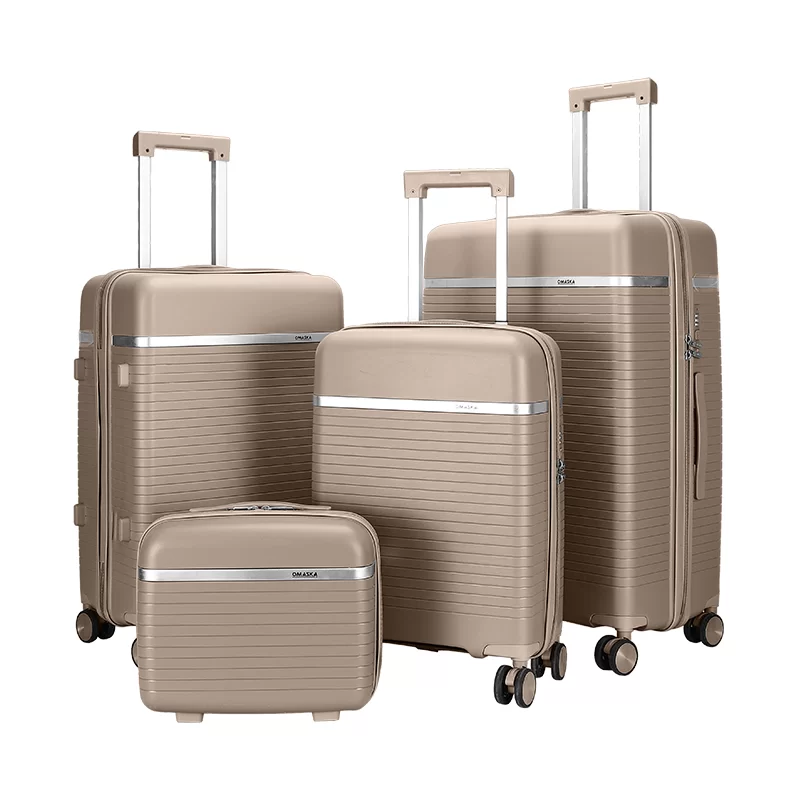
Model TSXPPB014 integrates a standardized three-piece sizing matrix featuring 20, 24, and 28-inch dimensions to align with international transport frameworks.
Each increment in the sizing ladder directly addresses specific transit durations, ranging from short regional flights to extended overseas voyages. Sourcing managers evaluate these tiers to ensure retail assortments accommodate varied end-user luggage capacity demands without incurring oversized baggage penalties from air carriers.

The structural geometry of nested shells allows smaller enclosures to fit directly within larger counterparts, drastically reducing empty volume during maritime transport.
Logistics planners calculate shipping container payload efficiencies based on this nesting ratio, as empty airspace directly inflates landed unit costs. Wholesale distributors leverage this dimensional hierarchy to maximize pallet configurations and lower total freight expenditures per set.
Minimum order quantities for model TSXPPB014 are established at 50 sets per color to align with industrial resin dyeing requirements. Sourcing managers evaluate these batch parameters to balance inventory holding costs against factory production efficiency.
Injection molding systems require dedicated color masterbatch integration and thermal purging phases before production runs commence. Operational workflows for this configuration depend on the specific color batch specifications provided in the purchase order.
Brand owners planning seasonal inventory procurement batches utilize the 50-set threshold to optimize warehouse storage and container utilization without incurring excessive factory downtime charges. Production documentation available from the supplier provides further details regarding color matching tolerances and pigment dispersion standards.

Procuring polymer luggage requires direct contrast between model TSXPPB014 specifications and standard industry baselines to identify optimal batch configurations. Sourcing teams evaluate injection-molding efficiency alongside physical dimension tiers before committing to production schedules. Establishing clear baseline comparisons prevents unexpected cost variances during high-volume purchasing cycles.
The core parameters of model TSXPPB014 are structured to meet specific volume and sizing parameters established for international distribution networks. The following matrix outlines the foundational attributes required for supplier evaluation.
| Material | Model | Size | MOQ | Suitability for Humid Environments | Price Tier |
|---|---|---|---|---|---|
| PP | TSXPPB014 | 20, 24, 28 inch | 50set/color | High resistance to moisture-induced degradation | Dependent on volume tiers |
Balancing batch sizing against injection mold setup efficiency involves direct trade-offs between unit cost and inventory flexibility. Smaller production runs increase mold changeover frequency, which impacts overall manufacturing throughput and extends lead times for non-standard color requests. Conversely, large-scale output maximizes cavity utilization but ties up capital in specific resin batches.

Procurement professionals navigate these constraints by aligning color batch requirements with the established minimum order threshold of 50 sets per color. This parameter governs the financial viability of resin dyeing setups without forcing excessive warehouse accumulation. Specific verification steps depend on the particular supplier evaluation workflow and the volume tier under negotiation.
Manufacturer production sites rely on structured facility evaluation protocols to substantiate incoming wholesale orders without referencing external legislative directives. Commercial sourcing teams assess foundational assembly capabilities by examining shop-floor workflow organization and resin storage management directly at the production source.
Factory operational audits govern batch consistency by evaluating injection machine maintenance records and material drying procedures.
Evaluating physical production controls ensures that molding parameters remain stable across extended fabrication shifts, preventing thermal degradation of the thermoplastic resin. Sourcing managers verify these operational baselines through direct factory evaluation reports rather than assuming uniform quality across different manufacturing sites.
Initial vetting procedures require verifying machine tonnage capacities and mold cavity precision before committing to multi-set inventory allocations. Production lines dedicated to model TSXPPB014 depend on calibrated cooling channels and automated clamping units to maintain uniform shell thickness across the designated dimensional tiers.
Quality management structures within the manufacturing plant maintain traceability from raw resin pellets through finished luggage nesting units. Operating frameworks inside the facility dictate that every production batch undergoes dimensional verification against master tooling templates.

Procurement teams cross-reference these operational findings against commercial purchasing agreements to align delivery milestones with actual plant output capacity. Factory vetting prerequisites remain strictly tethered to observable plant floor metrics and material handling protocols, ensuring that wholesale buyers evaluate manufacturing viability based on verifiable structural capabilities rather than ungrounded claims.
Conducting systematic operational audits ensures that incoming polymer luggage shipments directly match approved baseline production documents without introducing unverified performance metrics.
Sourcing managers integrate structured evaluation checklists during initial supplier assessments to verify that manufacturing output aligns precisely with designated core materials and sizing structures. By cross-referencing factory floor procedures against authorized specifications, commercial buyers eliminate discrepancies related to unlisted laboratory tests or unauthorized resin modifications before financial commitments are finalized. This verification workflow relies entirely on direct observation of injection molding parameters and raw material handling protocols.

Verifying manufacturing credentials requires strict adherence to documented parameters rather than accepting speculative compliance claims during procurement audits.
External supply chain vulnerabilities often emerge when unverified durability metrics replace core technical parameters in purchase contracts. Sourcing teams prevent these risks by restricting compliance reviews to authorized production records and verified factory capabilities. Depending on the scale of the commercial order and final destination port requirements, audit depth varies directly with batch scheduling and resin allocation timelines.
Evaluating overall compliance for polymer injection-molded luggage shipments demands a disciplined sequence of verification steps. Commercial procurement officers examine shell material consistency, multi-size nesting dimensions, and color batch minimums against initial purchase agreements. Finalizing supply agreements depends on maintaining transparent operational visibility across every active production cycle.
The core shell utilizes polypropylene to balance impact resistance with high-volume injection molding efficiency. This polymer selection supports continuous commercial output without incorporating unlisted structural resin categories or specific melt index metrics. Production documentation available from the manufacturer details the exact formulation parameters.
The unit features a structured multi-size configuration consisting of 20, 24, and 28-inch dimensions designed to match international airline baggage limits. This tiered sizing framework optimizes volumetric cargo space during maritime transport through a nested arrangement.
Sourcing parameters require a minimum order quantity of 50 sets per color variant. This batch sizing accommodates specific resin dyeing requirements and injection mold setup procedures during factory scheduling.
Factory operations integrate established quality management protocols and operational oversight systems. Sourcing managers can obtain relevant verification documents directly through initial supplier vetting procedures.
Buyers assess shade uniformity based on color-specific resin dyeing runs tied to the 50-set minimum order threshold. Production parameters depend heavily on pigment dispersion stability and injection pressure controls during cavity filling.
Commercial purchase orders for model TSXPPB014 require careful synchronization between resin color batches and minimum order thresholds. Importers coordinate their delivery schedules directly with factory production queues to ensure timely arrival at regional distribution hubs.
Sourcing managers finalize their procurement execution by calculating exact volumetric requirements against destination port logistics and seasonal inventory targets.





Hit enter to search or ESC to close


If you are interested in our products, you can choose to leave your information here, and we will be in touch with you shortly.


